
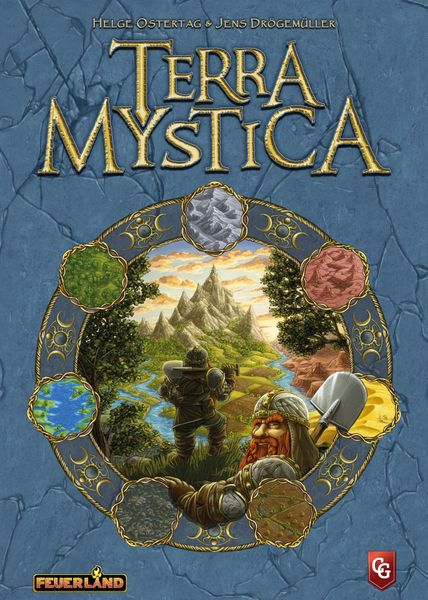
Terra Mystica RL
High-performance board game AI environment
Overview
Board games have long been the proving ground for Artificial Intelligence. While Chess and Go have fallen to superhuman algorithms, modern Euro-style board games present a new frontier. This project brings Terra Mystica, a masterpiece of zero luck and perfect information, into the realm of deep reinforcement learning. It is a rules-complete, high-performance environment written in Rust, designed to push the boundaries of multi-agent planning.
Sample AI game playthrough
What is Terra Mystica?
At its heart, Terra Mystica is an economic engine-building game played on a shared hex map. 2 to 5 players each control a unique fantasy faction (like Witches, Giants, or Nomads) and attempt to terraform the landscape to suit their needs.
The goal is deceptively simple: score the most Victory Points (VP) by the end of Round 6. However, getting there requires navigating a tight economy. You must upgrade buildings to generate income (workers, money, priests), but expanding your territory requires spending those same resources. The game is famous for having zero luck. There are no dice and no card draws. Every outcome is the direct result of player decisions.
Why This Matters for AI
For an AI researcher, Terra Mystica is fascinating because it breaks traditional molds. It combines the deterministic purity of Go with the heterogeneous asymmetry of a modern video game.
- Deep Asymmetry: The agent can’t just learn how to play once; it must learn how to play as 14 distinct factions, each with unique abilities, costs, and starting positions.
- Tight Resource Coupling: Resources in Terra Mystica are deeply interdependent. You aren’t just optimizing one metric; you’re balancing a complex equation where spending a “Priest” now might cost you a “Spade” three turns later.
- The “Power” Mechanic: The game features a unique resource called “Power” that is gained when opponents build next to you. This creates a fascinating spatial tension: you want to be near opponents to leach off their actions, but being too close chokes your physical expansion.
Beyond Chess: The N-Player Challenge
Game theory is often thought of through the lens of the Minimax algorithm, where if one player wins, another loses. This holds true for 2-player zero-sum games like Chess. But Terra Mystica is usually played with 3 to 5 players, and that changes the theoretical landscape entirely.
In an N-player setting, the standard “your loss is my gain” assumption breaks down. A move that hurts the leader might benefit a third party more than the actor. This introduces complex dynamics:
- The Multiplayer Zero-Sum Problem: Traditional algorithms like AlphaZero are optimized for binary outcomes. Adapting them to handle the relative value of actions in a group setting is a significant open challenge.
- Kingmaking: Agents must learn to navigate scenarios where a losing player’s actions effectively decide the winner among the remaining contenders. This is a common phenomenon in multiplayer board games that is theoretically distinct from optimal play in 2-player settings.
- Unstable Nash Equilibria: Unlike 2-player equilibria which are generally stable, N-player equilibria can be cyclical or highly sensitive to opponent policy variations.
Learn More
To dive deeper into the code, architecture, and implementation details, check out the project on GitHub: